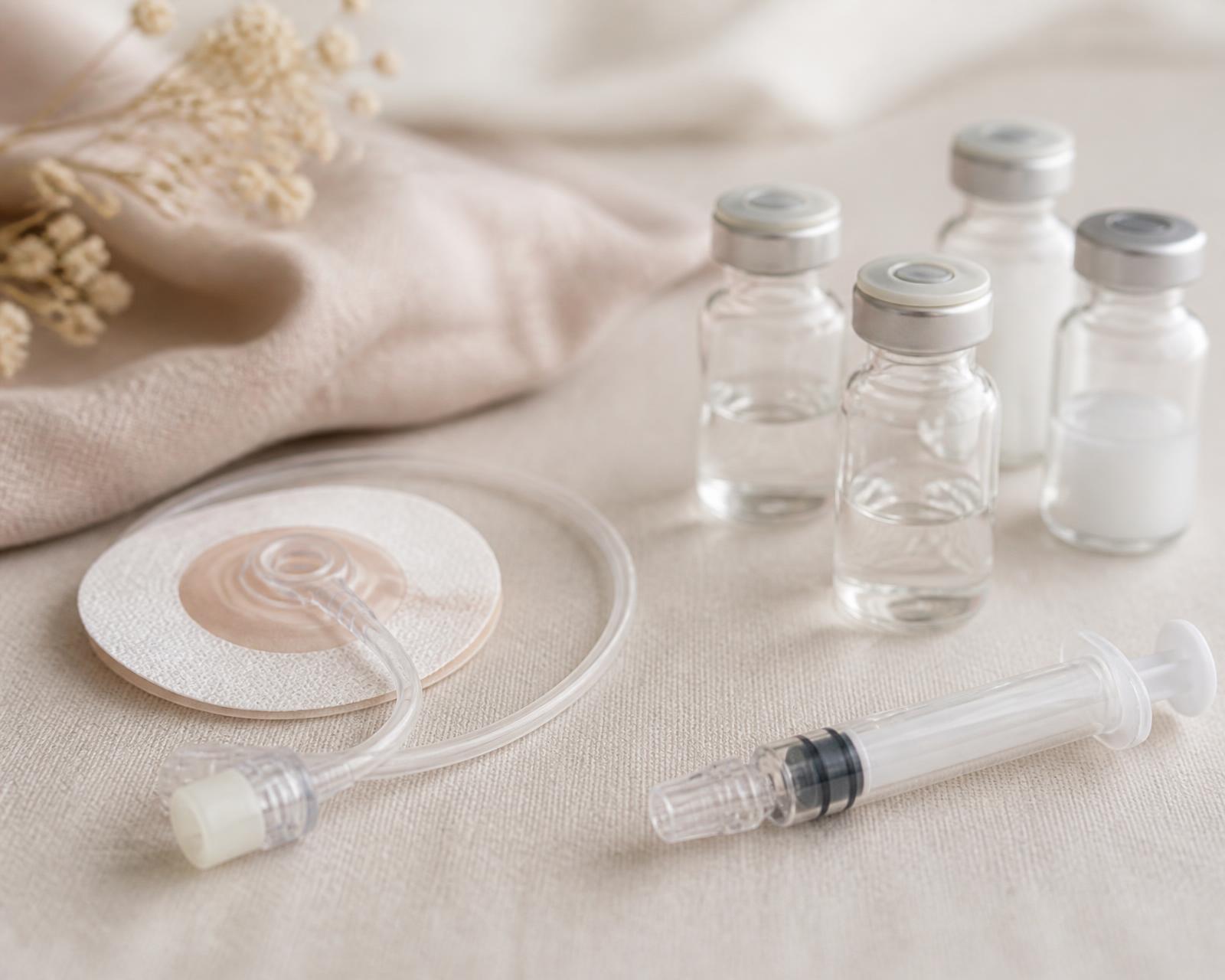
What Needle-Free IVF is
Needle-Free IVF is a medication-delivery option now offered through HRC Fertility. It was developed within HRC Fertility, drawing on approaches used elsewhere in medicine, for patients who find the injection portion of treatment difficult.
Rather than changing what medications you take or how a cycle is designed, it changes how many of those medications reach you. A small adhesive catheter is placed on the abdomen, and compatible subcutaneous medications are administered through that catheter instead of through a new needle injection at home each time.
It is important to be precise about what this does and does not mean. Needle-Free IVF reduces the need for repeated at-home needle injections during stimulation. It does not eliminate every needle that may be involved in fertility care, and it is not represented as improving egg quality, embryo quality, implantation, or pregnancy outcomes compared with conventional administration.
How it works
The device is a quarter-sized adhesive catheter placed on the abdomen. Beneath the skin sits a small, approximately 9 mm flexible port. Once it is in place, compatible subcutaneous fertility medications are given through the catheter rather than through a separate injection each time.
Placement is done in the office by trained staff, not at home. It generally remains in place throughout ovarian stimulation, which is typically about 9–12 days, and is usually inserted or replaced only once or twice across that window rather than requiring a new injection site for every dose.
After each administration, the tubing is flushed with a syringe of sterile saline provided to you, so no medication is left sitting in the line.
Who may benefit
Needle-Free IVF may be especially appealing to patients who are preparing for IVF or for egg freezing and who find the injection portion of stimulation hard — physically, emotionally, or both.
- Patients undergoing IVF
- Patients undergoing egg freezing
- Patients who experience needle anxiety or distress
- Patients who find repeated injections physically or emotionally difficult
- Patients who want a potentially more comfortable or more manageable medication experience
- Patients who have delayed, paused, or struggled with treatment because of injection-related anxiety
Deciding whether it is right for you
Eligibility and medication compatibility are determined by your fertility care team. Your physician and nursing team review your planned protocol, confirm which of your medications can be given through the catheter, and discuss whether this option fits your cycle.
Medication compatibility
Needle-Free IVF is designed for compatible subcutaneous medications. Those medications need to connect to the catheter using a luer lock, or twist-on, syringe. Medications supplied in a pen or with a non-removable needle may require an additional step to be converted into a compatible form.
Intramuscular medications are not administered through the Needle-Free IVF catheter. For that reason, not every medication used across an IVF cycle can be given through the device, and some injections may still be part of your plan. Your care team will tell you exactly which of your medications go through the catheter and which do not.
Daily life with the device
Most patients continue their normal daily activities while the catheter is in place.
- You can shower normally, avoiding soap directly on the adhesive.
- Exercise is generally possible.
- Use caution with swimming and with activities that involve significant heat or sweating — saunas, steam rooms, hot yoga, and similar — because these can weaken the adhesive.
Risks and considerations
Some risks are similar to those of a standard needle injection, and others are specific to wearing an adhesive catheter. Reported risks include bruising, redness, adhesive sensitivity or allergic reaction, and rare infection.
Insertion is described as quicker and less uncomfortable than a needle injection, but it is not painless. Your consent form lists the complete set of risks, and your care team will review them with you before placement.
Frequently asked
What is Needle-Free IVF?
It is a medication-delivery option available through HRC Fertility. A quarter-sized adhesive catheter with a small, roughly 9 mm flexible port is placed on the abdomen so compatible subcutaneous stimulation medications can be given through the catheter instead of through a new needle injection each time.
Does Needle-Free IVF eliminate all needles?
No. It substantially reduces repeated at-home needle injections during stimulation, but it does not remove every needle from fertility care. Intramuscular medications, for example, are not given through the catheter.
How long does the catheter stay in place?
It generally stays in place for the duration of ovarian stimulation, usually about 9–12 days. It is typically placed or replaced only once or twice during that period.
Can Needle-Free IVF be used for egg freezing?
Yes. It is offered for the stimulation phase of egg freezing as well as IVF, since both use similar subcutaneous medications.
What medications can be administered through it?
Compatible subcutaneous medications that connect with a luer lock, or twist-on, syringe. Medications in a pen or with a non-removable needle may need an extra step to become compatible. Intramuscular medications are not compatible.
Can I shower with it?
Yes. You can shower normally, but avoid putting soap directly on the adhesive.
Can I exercise with it?
Yes, exercise is generally possible. Use caution with swimming and with high-sweat or high-heat activities such as saunas, steam rooms, and hot yoga, which can weaken the adhesive.
Does placement hurt?
Placement is described as quicker and less uncomfortable than a needle injection, but it is not painless. It is done in the office by trained staff, usually only once or twice per cycle.
Who is a good candidate?
Patients preparing for IVF or egg freezing who experience needle anxiety, find repeated injections difficult, or want a potentially more manageable medication experience. Eligibility and medication compatibility are confirmed by your fertility care team.
Are there risks?
Yes. Some are similar to a needle injection, such as bruising and redness. Others relate to the adhesive catheter itself, including allergic reaction and rare infection. Your consent form lists the complete set of risks.